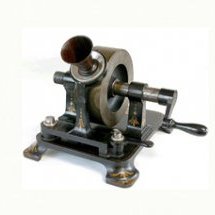
Tinfoilphono Posted 5 hours ago Posted 5 hours ago MODEL: AQ YEARS MADE: 1903 to ca. 1908 COST: $3 CASE/CABINET SIZE: base 12" x 5.5" REPRODUCER: fixed in place MOTOR: single spring HORN DIMENSIONS: 10" REPRODUCTION PARTS: none This is certainly not a great rarity, however it is a bit unusual and very interesting. It's also something of a mystery. Columbia never advertised or catalogued it, so why was it made in the first place? It's an offshoot of the previous Type AP, which was Columbia's attempt to make a European-style 'Puck' phonograph, with basic motor and no feedscrew to guide the reproducer. It was carried by the grooves of the cylinder itself, and would skid across the record if it wasn't perfectly level. One of the rear 'feet' was adjustable to level the base. The AP is fairly rare, and was obviously not successful. At some point Columbia opted to take the existing AP base and motor and add a very crude feedscrew to make it more reliable. The connection between the horn and reproducer was improved, along with the horn mount. But otherwise it was pretty similar. Reportedly the AQ was priced at $3, or $2 less than the basic Type Q. But since Columbia evidently didn't market them directly, its purpose is vague. The only known ads showing the AQ offer it as a "premium machine," that was given away for free with the purchase of other items (which were presumably heavily marked up to cover the cost of the AQ). Later, Columbia liquidated stocks of AQ Graphophones through Sears Roebuck, replacing the cone horn with a brass-belled horn which, while short, had a fairly large diameter bell. These were marketed as "Oxford Jr." In my experience there are more surviving Oxford versions than the earlier style. Both are moderately scarce, especially compared to the very common Type Q. It's actually a pretty well-made little machine, despite its obviously cheap construction. The motor is essentially the same as a Q, but with the spring and drive gears covered. The governor remains open, as in the Q. It runs pretty quietly and plays surprisingly well, especially given that my reproducer has not been rebuilt. The base is identical to the AP except that the leveling foot has been replaced with a fixed brass one. This is probably an early example, with "KEEP LEVEL" stamped on the gear cover -- a carry-over from the AP. What is most surprising to me about this example is the condition. It's quite amazing for a cheap machine which never had a cover. It must have had a short working life, so I wonder how it survived well over a century in such nice condition.
phonogfp Posted 3 hours ago Posted 3 hours ago That's a sweetheart, Rene! If I saw one like it (condition) at a show, I'd be very tempted. George P.

Recommended Posts
Create an account or sign in to comment
You need to be a member in order to leave a comment
Create an account
Sign up for a new account in our community. It's easy!
Register a new accountSign in
Already have an account? Sign in here.
Sign In Now